1. About IslandsLib
1.1. What Islandslib is
IslandsLib is a python library that provides a set of functions and classes to build a simple 2D model of and island’s freshwater lense.
IslandsLib builds on the pyfreefem library and FreeFem++ software to provide a simple function IslandLens()
to model freshwater lenses without a prior knowledge of Finite Element Modeling.
Given a set of contour data and constraints if will model the freshwater lens of a small island.
A small island is here defined as an island without a river network.
Lakes can be included (see examples), and river networks will be included in later versions of IslandLens(). If you want to solve problems with river networks
you need to use the set of functions provided or to use pyFreeFem directly.
IslandsLib also provides functions to process IGN (French National Geography Institute) products. Functions used for IGN products are meant to help you create single coastline contours from shapefile for the purpose of modeling the Poisson equation. They can also be used to extract elevations from DEMS for different purposes (defining boundary conditions in particular).
Eventually IslandsLib also provides a repository of Island contours. Please feel free to contribute !
1.2. What IslandsLib is not
IslandsLib is not a Finite Element Model Solver It relies on the pyFreeFem library developped by Olivier Devauchelle (https://github.com/odevauchelle/pyFreeFem) a python wrapper around the FreeFem++ Solver (https://freefem.org/). As such both pyFreeFem and FreeFem++ must be installed on your computer in order to use IslandsLib
IslandsLib is not a Plug and Play IGN Data Converter Functions are provided to help transform contours, especially those disclosed by the French Geographic Institute (IGN). The functions and procedures can be used with basically any set of contours but they require a bit of work. An example of single contour création from in IGN shapefile is given
1.3. What are Freshwater Lenses and Why Bother for Them
1.3.1. Origin of Island Freshwater: Example of Rangiroa, French Polynesia
An atoll is a ring-shaped island made up of a coral reef, built on the flanks of an ancient volcano and surrounding a lagoon. These unique geological formations rise only a few meters above sea level; they are therefore among the most vulnerable to sea level rise and extreme weather events.
We here use the example of Rangiroa to present the challenges associated with the supply of fresh water to these small islands. Rangiroa is the largest atoll in the Tuamotu archipelago of French Polynesia (Figure GoogleEarth image of the Tuamotu and Rangiroa archipelago consani2025). The “island” of the atoll, in the case of Rangiroa, comprises 415 small coral islands called motus, of which only two are permanently inhabited. In 2017, its population represented 6% of the total inhabitants of French Polynesia, or 2,700 inhabitants [White et al., 2007].
Atolls like Rangiroa face several constraints: low topography, lack of a hydrographic network, geographic isolation, and high climate variability. These conditions severely limit access to freshwater, which relies on rainwater harvesting, seawater desalination, and groundwater exploitation. However, desalination involves particularly high operating costs, while rainfall is marked by strong seasonality and sensitive to climate change. Groundwater therefore appears to be a key resource for securing freshwater supplies for island inhabitants. However, little is still known about this resource which is vulnerable to climate effects and human actions.
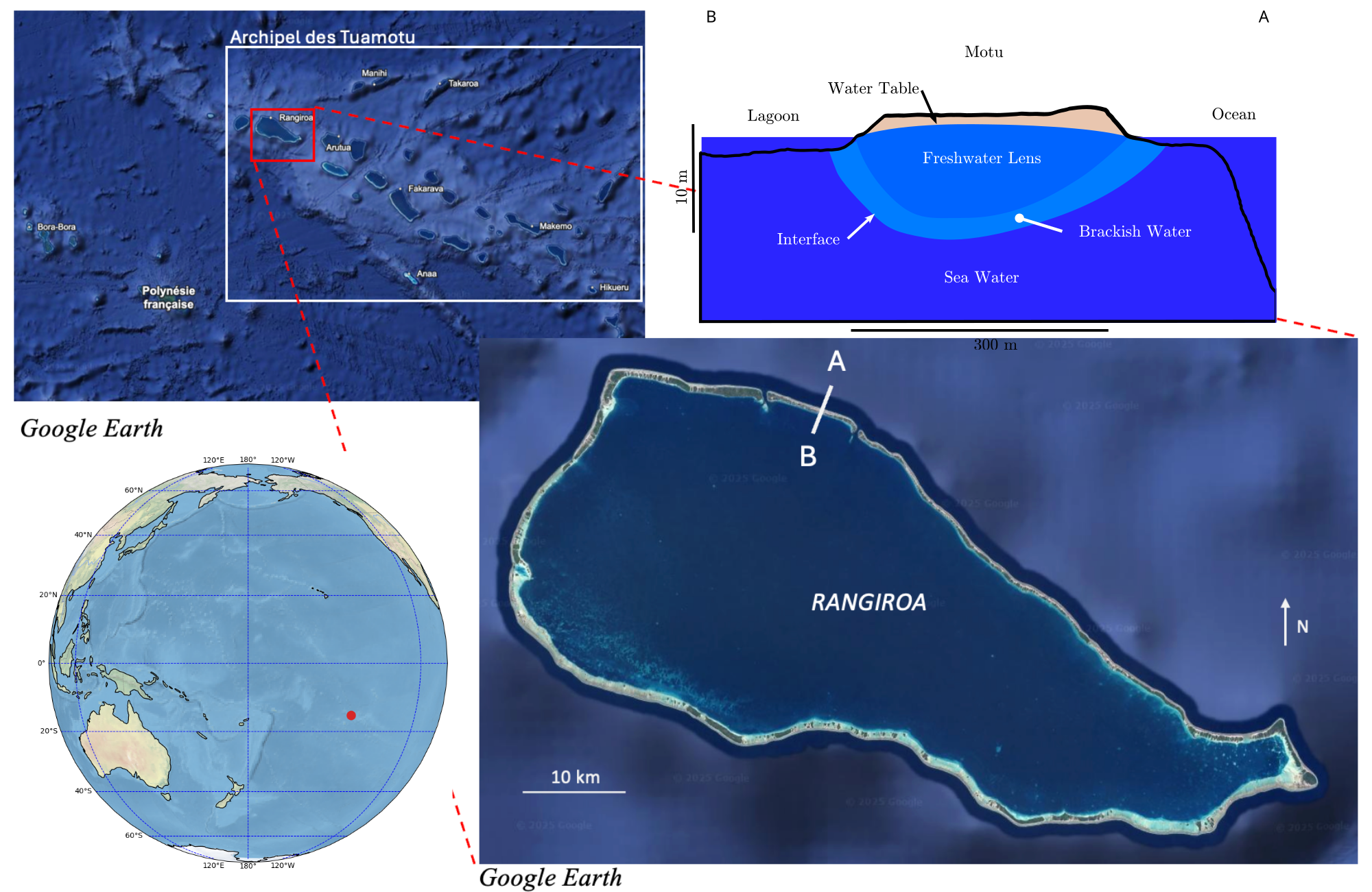
GoogleEarth image of the Tuamotu and Rangiroa archipelago [Consani-Carré, 2025]
1.3.2. Freshwater Lens: a Fragile and Threatened Resource
Fresh groundwater comes from precipitation. This seeps into the porous coral reef soils and is temporarily stored beneath the island before flowing out into the ocean or lagoon. This fresh groundwater rests on the heavier salt water to form a lens (Figure Idealised cross section of a Motu. Simplified from werner2017hydrogeology), whose thickness varies from a few tens of centimeters to about ten meters [Bailey et al., 2009]. The contact zone between fresh and salt water constitutes a mixing zone between fresh and salt water, also called the transition zone or interface.
The shape of the lens depends on three factors: the width of the island, recharge (precipitation – evaporation) and hydraulic conductivity [Werner et al., 2017]. The volume contained in the lens also depends on the porosity of the soil. The balance of this lens is fragile: its shape and volume can be impacted by natural and anthropogenic phenomena. Indeed, the tides cause the water table to rise by hydrostatic pressure, increasing the mixing zone. The freshwater-saltwater interface can also rise following excessive extraction. Finally, rising sea levels would cause the freshwater-saltwater interface to rise by hydrostatic uplift, thus reducing the volume of freshwater stored in the lens. All these processes contribute to the phenomenon of aquifer salinization.
Sustainable management of these aquifers therefore represents a real challenge, particularly in the inhabited areas of these islands. It is crucial to determine the volume of freshwater available, and the impact of salinization on this volume, in order to develop sustainable extraction methods. To do this, it is necessary to estimate the stocks and flows of the lens, as well as their potential changes.
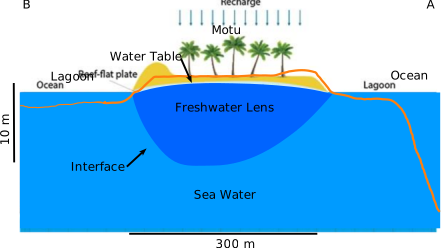
Idealised cross section of a Motu. Simplified from [Werner et al., 2017]
1.3.3. Modeling an Island’s Freshwater Lens
Under certain conditions, the water table of an island can be modeled using the following form of the Poisson equation, named after the French Mathematician Simeon Denis Poisson (1781-1840):
where \(\Delta z_d\) is the Laplacian of the water table elevation \(z_d\) above sea level, \(R\) is the recharge (the water that infiltrates), \(K\) is the average hydraulic conductivity, and \(\rho_s,\rho_d\) are the densities of seawater and freshwater respectively.
The resulting stationnary water table corresponds to an average level. This model pictured on Cross section of the Freshwater Lens of Petite Terre metivier2024bilan assumes that
the lens is fully developped, hence pores are saturated with salt (sea) water everywhere beneath the freshwater;
the vertical component of velocity in the lens is neglected (Dupuit-Boussinesq approximation);
the flow velocity in the salt water is negligible and pressure balance at the saltwater-freshwater interface is hydrostatic;
the interface between salt and freshwater is thin (we neglect the brackish water zone of figure Idealised cross section of a Motu. Simplified from werner2017hydrogeology).
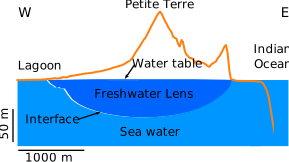
Cross section of the Freshwater Lens of Petite Terre [Métivier et al., 2024]
Under theses assumptions the depth of the Freshwater-saltwater interface \(z_s\) can be deduced from the water table by
For a complete discussion on the model see for example Métivier et al. [2024] (https://hal.science/hal-04632890v1). For a discussion on atolls and the applicability of the Poisson equation to small islands see also Consani-Carré [2025].
1.3.4. References
Ian White, Tony Falkland, Pascal Perez, Anne Dray, Taboia Metutera, Eita Metai, and Marc Overmars. Challenges in freshwater management in low coral atolls. Journal of Cleaner Production, 15(16):1522–1528, 2007.
Carla Consani-Carré. Modélisation et prise en compte de la salinisation des nappes phréatiques pour les petites îles. Stage de 3ème année de Licence, Institut de Physique du Globe de Paris, 2025.
Ryan T Bailey, JW Jenson, and AE Olsen. Numerical modeling of atoll island hydrogeology. Groundwater, 47(2):184–196, 2009.
1.4. Contributors
François Métivier, Professor of Geophysics, IPGP & U. Paris Cité, metivier[@]ipgp.
Carla Consani-Carré, Bachelor of Arts and Sciences, Institut d’études politiques de Paris & IPGP
Thomas Gauthier-Brouard, ENS Paris.
1.5. Support
We are indepted to adoptacoastline NGO who gave us the opportunity to access the blue zone of UNOC in 2025, and meet with representatives of small island developing states (SIDS) who expressed their deep concern about the impact of rising sea levels on their resources.
This work is supported by the RESAM project (Ressource en eau et stratégies d’adaptation pour faire face à la pénurie : le cas de Mayotte) and the Geological fluid Dynamics Laboratory of IPGP.